
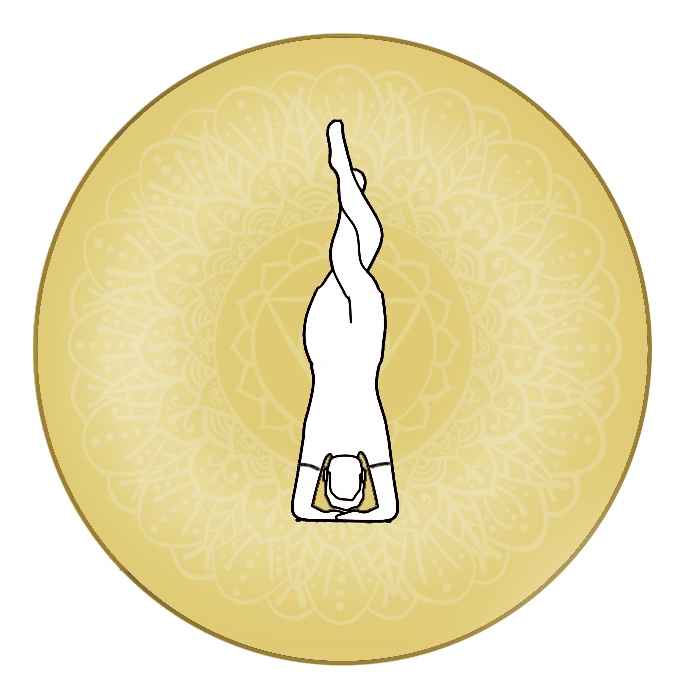
Steps:
Here are the steps of the yoga pose:
How to Practice Supported Headstand (Salamba Sirsasana)
- Begin in a kneeling position and bring your forearms to the mat.
- Hold onto opposite elbows to measure the correct distance between your arms.
- Keeping your elbows grounded, release your grip and interlace your fingers, forming a supportive triangle with your arms.
- Place the crown of your head gently on the floor, allowing the back of your head to rest in your interlaced fingers. Most of your weight should remain in your forearms.
- Tuck your toes under and lift your knees off the mat, raising your hips to form an inverted “V” shape.
- Exhale and begin walking your feet toward your head, gradually bringing your hips over your shoulders.
- Draw one knee into your chest, followed by the other, using your core to find balance and control.
- On your next exhale, slowly extend your legs upward, reaching through your feet while keeping your ribs slightly drawn in.
- Fix your gaze on a point in front of you and breathe steadily, holding the pose for a few breaths or up to a minute.
- To exit, bend your knees into your chest, lower your feet to the mat with control, and rest in Child’s Pose.
Dos and Don’ts:
DOs and DON’Ts of Supported Headstand Pose(Salamba Sirsasana)
DOs
- Warm up properly before attempting the pose—focus on shoulders, neck, core, and hamstrings.
- Use a wall for support if you’re a beginner or still building balance and control.
- Ensure engagement of your core muscles to support your spine and maintain stability.
- Keep most of your weight in the forearms instead of your head or neck.
- Press your elbows firmly into the mat as this can create lift and reduce pressure on your head.
- Maintain slow, steady breathing to help with focus and alignment.
- Come out of the pose gently, lowering with control and resting in Child’s Pose afterward.
- Practice under supervision if you’re new to inversions or returning after an injury.
DON’Ts
- Don’t attempt the pose without preparation or shoulder and core strength.
- Don’t place all your weight on your head, as this can strain the cervical spine.
- Don’t rush the ascent—kick-ups can destabilize you and lead to injury.
- Don’t hold your breath—maintain a calm, even rhythm to support balance and awareness.
- Don’t practice if you have neck issues, high blood pressure, glaucoma, or are pregnant.
Don’t rotate or move your head while inverted keep it stable to avoid strain.
Share Pose


