
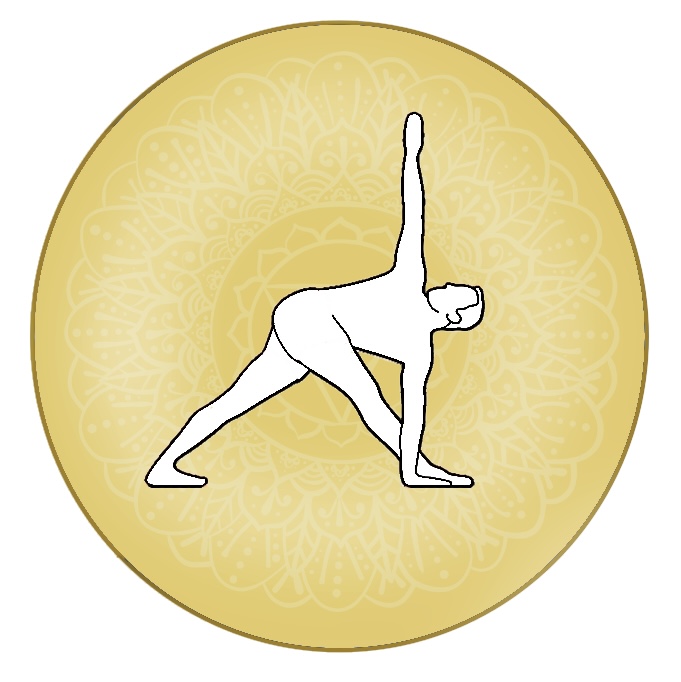
Steps:
Here are the steps to practice the Extended Triangle Pose:
- Stand tall in Tadasana (Mountain Pose) at the top of your mat.
Place your left foot slightly inward and your right foot out 90 degrees as you step your feet three to four feet apart. - Position the heel of your front foot so that it is in line with the arch of your back foot.
- Stretch your arms out to the sides at shoulder height, with palms facing down.
- With an exhale, reach your right hand forward past your toes, lengthening through your side waist.
- Lower your right hand to rest on your shin, ankle, or a block outside your right foot, whichever keeps your chest open and aligned.
- Align your left arm with your shoulders and extend it toward the ceiling.
- Keep your torso open and avoid collapsing over your front leg. Gaze upward, forward, or downward based on your neck comfort.
- Engage your thighs, press into both feet, and hold the pose for 5–10 breaths.
- Inhale to rise back up
- Simply switch the feet to repeat on the opposite side.
DOs and DON’Ts:
DOs:
- Engage your core to support your spine.
- If you can’t comfortably reach the floor, use a block under your lower hand.
- Maintain a broad chest and ensure your upper shoulder is aligned above the lower one.
- Maintain even weight distribution between both feet.
DON’Ts:
- Don’t overreach or twist the torso downward.d.
- Don’t hyperextend the front knee.
- Don’t lock your knees.
- Don’t rest your lower hand directly on your knee (to avoid strain).
- Don’t force your neck to look upward—keep it neutral if needed.
Don’t hold your breath; keep it steady and relaxed throughout.
Share Pose


