
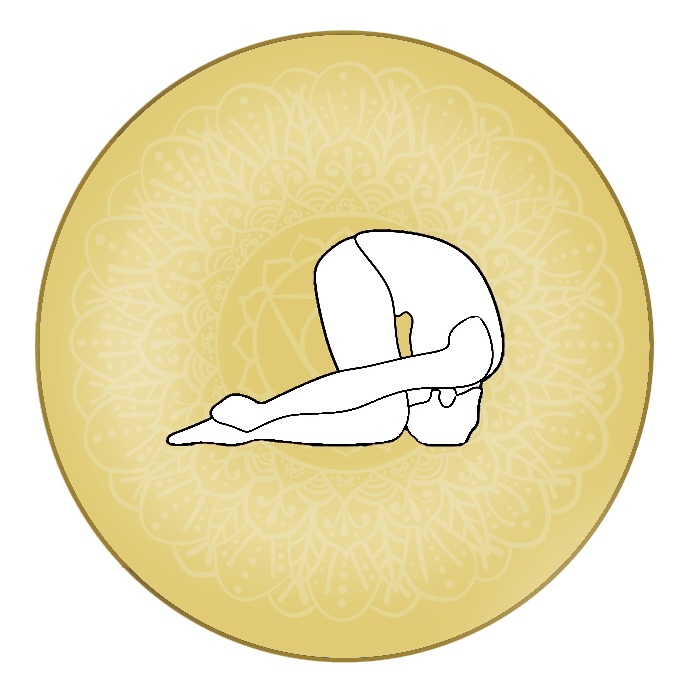
Steps for Rabbit Pose:
- Begin in Child’s Pose, with knees hip-width apart and arms reaching toward the feet.
- Slowly lift your hips while keeping your forehead on the mat.
- Reach back and hold your heels with your hands, palms facing down and thumbs on the outside.
- On an inhale, tuck your chin toward your chest and place the crown of your head gently on the mat, close to your knees.
- With an exhale, lift your hips toward the ceiling while maintaining your grip on the heels.
- Let your arms stay active and gently pull on the heels to deepen the stretch through the spine.
- Keep the back rounded, and avoid placing pressure directly on the neck.
- Hold the pose for 3–5 breaths, or longer if comfortable, with steady breathing.
- To release, slowly lower the hips back down, release the heels, and return to Child’s Pose to neutralize the spine.
DOs and DON’Ts:
DOs:
- Engage your core to support the spine during the lift.
- Keep the weight distributed evenly through the crown of the head and knees.
- Use a folded blanket under your head if needed for support or neck sensitivity.
- Keep your grip firm on the heels to maintain balance and spinal traction.
- Breathe slowly and steadily throughout the pose.
DON’Ts:
- Don’t force your head onto the mat. Let the placement be gentle and guided by breath.
- Don’t strain your neck or place all your body weight on it.
- Don’t rush into the pose; enter and exit with care and control.
- Don’t practice this pose if you have serious neck, spinal, or shoulder injuries.
Don’t hold the pose if you feel dizzy or experience discomfort in the head or neck.
Share Pose


