
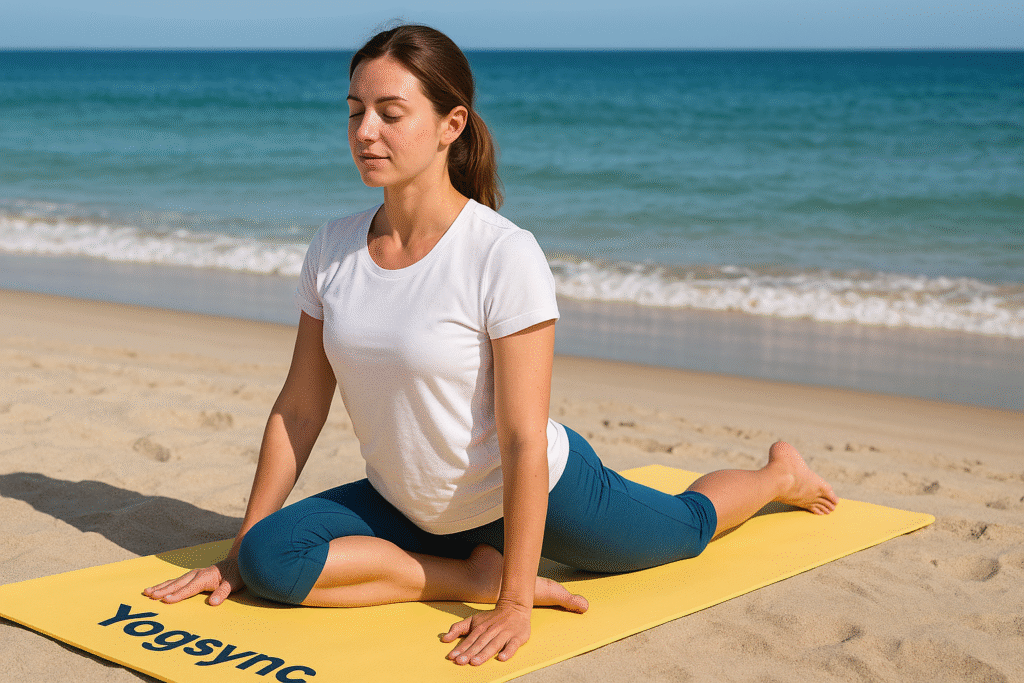
Unlock Your Hips and Release the Heart With Pigeon Pose
Ease into Pigeon Pose to gently open your hips, release lower-back tension, and calm your mind. Perfect for beginners, this pose teaches patience, mindfulness, and emotional release one breath and one stretch at a time.
by Yogsync Team
Imagine sinking into stillness, one leg folded beneath you, the other extended behind. Your hips slowly soften as gravity pulls you closer to the earth. You breathe deeply—not just into your lungs, but into the very places where tension hides. That’s the calmness you get with Pigeon Pose, a posture that meets you where you hold the most—physically and emotionally. For many beginners, it’s a love-hate relationship. It’s intense, yes—but also incredibly freeing. With patience, Kapotasana becomes less about achieving the perfect shape and more about learning to release, breathe, and open up—one breath, one hip at a time.
Origin & History
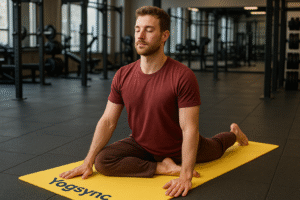
Kapotasana, the basic Pigeon Pose, appears to be a modern yoga development. Its current form was first described in B.K.S. Iyengar’s “Light on Yoga” in the 20th century. However, a different standing pose shared this name in the 19th-century Sritattvanidhi. The pose derives its name from the Sanskrit “kapota,” meaning pigeon, but rather than simply mimicking the bird, it honors the great yogic master Kapota, whose accomplishments are documented in ancient scriptures like the Mahabharata and Kalika Purana. While Kapotasana isn’t explicitly mentioned in the earliest Vedic texts dating back over 5,000 years, poses resembling it began appearing in medieval Hatha yoga texts like the Hatha Yoga Pradipika, which emphasized flexibility, balance, and the symbolic significance of surrender to the divine through deep backbending.
Benefits of Pigeon Pose
Though it’s often called a “deep stretch,” Pigeon Pose offers far more than just physical flexibility. It’s a holistic posture with mind-body benefits that go well beyond the hips:
-
Deep Hip Opening
The front leg position stretches the glutes, piriformis, and outer hip, while the back leg opens the hip flexors and psoas. This dual action releases tightness built from sitting, running, or cycling. -
Relieves Lower Back Tension
By softening the hip joints and promoting spinal extension, Pigeon Pose can reduce compression in the lower back and help relieve sciatic nerve discomfort (when done with care). -
Improves Posture and Mobility
As the pose promotes better hip rotation and pelvic alignment, it indirectly enhances posture, balance, and gait, making everyday movement more fluid. -
Supports Emotional Release
According to yogic philosophy and fascia theory, unprocessed emotions can be stored in the hips. Staying in Pigeon Pose for several breaths can trigger an emotional release—leading to a lighter, more spacious mental state. -
Encourages Stillness and Mindfulness
Holding the pose, especially in Yin yoga, develops patience and breath awareness. It teaches you to sit with discomfort, observe your thoughts, and slowly release both tension and expectation.
Variations for All Levels
Pigeon Pose can be intense, especially for those with tight hips or knee sensitivities. Fortunately, it offers many variations to meet every practitioner comfortably:
-
Reclined Pigeon (Figure 4 Pose)
Lying on your back, cross one ankle over the opposite thigh and gently draw the legs toward the chest. This version protects the knees and offers a controlled hip release. -
Seated Pigeon on a Chair
Perfect for office workers or those with limited mobility, this variation involves crossing one leg over the other while seated, gently folding forward for a stretch. -
Supported Pigeon with Props
Placing a folded blanket or yoga block under the front hip can make the pose more accessible and reduce pressure on the knees and lower back. -
Forward-Folding Pigeon
Gently walk your hands forward and rest your forehead on the mat or a block. This allows a deeper surrender and a more introspective experience. -
King Pigeon (Advanced Backbend)
The full expression involves bending the back knee and reaching for the foot with both hands, forming an elegant backbend. This should only be attempted with ample warm-up and experience.
Conclusion
Pigeon Pose teaches stillness, challenge, and release. It doesn’t ask for perfection—only presence. Whether you find yourself resisting its intensity or melting into its depth, this posture is a journey inward, unlocking spaces you didn’t know were holding on. For beginners, it offers one of the most transformative experiences in yoga—not just for the hips, but for the heart. So the next time you step into kapotasana, remember: the magic lies not in how far you fold, but in how deeply you feel.
Share article



Related Articles
Bridge Pose Yoga for Beginners with Origin and Key Benefits
Bridge Pose is a calming beginner-friendly posture that helps you build strength and flexibility while…
Warrior 3 Pose: Finding Balance Through Strength and Stillness
Step into Warrior 3 Pose and discover strength in stillness this beginner-friendly balance posture tones…
Warrior 2 Pose: Origin Story & Powerful Key Benefits
Begin your yoga journey with Warrior Two Pose a gentle yet powerful stance that builds…