
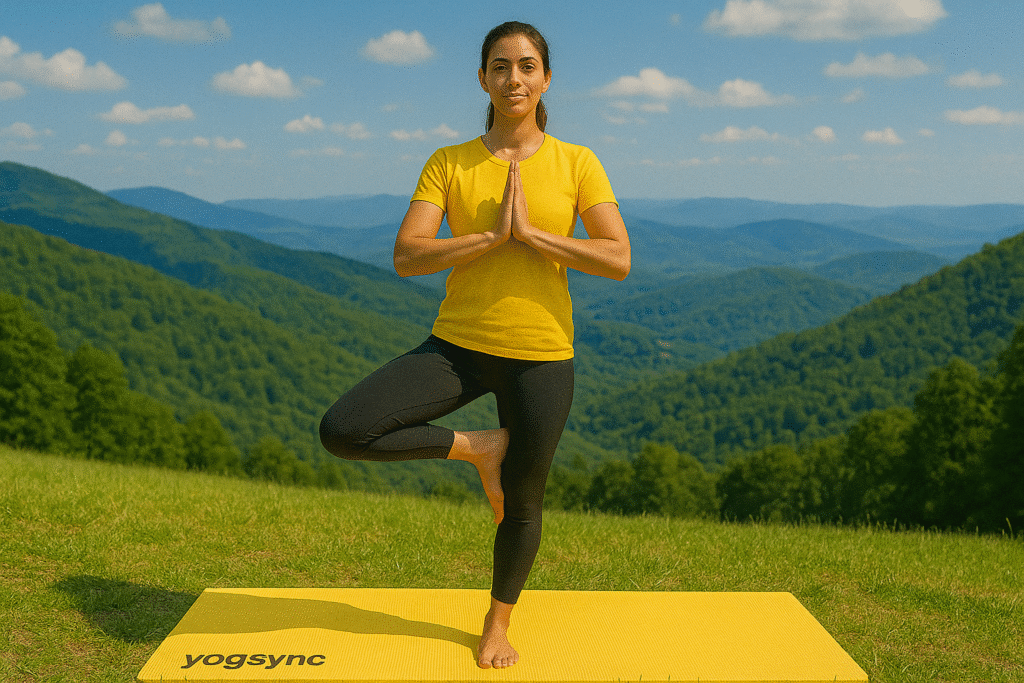
Find Lasting Stability and Focus with the Tree Pose Yoga Flow
Tree Pose is a gentle way to build balance and focus helping you stand tall, strengthen your legs, and find calm just like a tree.
by Yogsync Team
What can we learn from trees? Resilience, patience, or strength? Or the way they’re grounded, stand tall, and stay connected with their roots? Well, the list can go on, and so can our discussion. Let us not divert ourselves and stay directed to something we’ve come here for, ie, The Tree Pose.
The Tree Pose provides the practitioner balance and stability, just like a tree. It is a balancing pose and, in fact, one of the few from medieval hatha yoga. In present-day yoga scenarios, it has caught great attention. The Tree Pose has made its way to many yoga magazines, and it’s no surprise considering its benefits.
Let us unwrap the origin and benefits of the Tree Pose!
The Introduction of The Tree Pose
Tree Pose is also known as Vrikshasana. Vrksh, from this term, means a tree, while asana refers to the pose. They collectively refer to it as a posture replicating a tree. This yoga posture requires you to balance yourself on a single leg while pressing the other one on the inner thigh of this leg. A stone carving from the 7th century, situated in Mahabalipuram, presents a picture similar to Vrikshasana. In those times, sages would meditate in this pose. This was their way of disciplining.
You can learn about the Tree Pose in Gheranda Samhita, a 17th-century Sanskrit text on yoga. Gheranda Samhita is said to have 32 postures out of 8,400,000 taught by Lord Shiva. The Tree Pose is mentioned in the 2nd chapter, verse 36.
You can also find The Tree Pose in hatha yoga as Shira Sukham Asana. It requires the students to focus while standing on one leg each to stay stable and strong. Just like a tree connects to the Earth and moves upward, Vrakshasana can help the energy flow within one’s body.
Benefits of The Tree Pose
Calling the Tree Pose a mere physical exercise is an understatement. It is a holistic practice that brings the mind, body, and spirit together. In the coming section, let us learn about the potential benefits the Tree Pose has to offer:
Balance and Stability
You need balance to practice the Tree Pose, which can benefit you in many ways, including better concentration. This enables the body to sense its position. This benefits your stability and overall coordination. Let’s not forget the role of engaged core muscles and strengthened ankles and legs in overall body control.
Core and Legs Strengthening
You need to hold the pose on a single leg for a while. This can help strengthen your thigh, ankle, or calf muscles. Balancing in this posture requires you to engage your abdominal and pelvic muscles. The engagement of the core muscles eventually strengthens them. This can result in better posture and stability.
Improves Focus and Concentration
If you’re struggling with the monkey mind, the Tree Pose can help you improve your focus and concentration. It requires you to apply your gaze (dhristi) at a fixed place. This can help you stay balanced and focused. Balancing can require you to shift your awareness across your body. This keeps you more present in the moment, eventually enhancing your concentration.
Better Posture
The Tree Pose requires an understanding of your body’s alignment. This involves balancing the foot on the groin, placing the hips and pelvis, and everything else. You align your entire body to balance yourself in this yoga pose. Regularly practicing it can elongate your spine and stabilize your pelvis and hips, eventually contributing to a better posture.
Benefits to Lungs and Diaphragm
The Tree Pose benefits the upper body in many ways, including better posture, flexibility, and concentration. Stretching your arms upwards during the pose actively involves the chest, rib cage, intercostal muscles, and diaphragm. This can also help you take deep breaths, which can support respiratory muscles and enhance lung function.
Variations to the Tree Pose
If you struggle with coordination and stability, opting for yoga variations can help. You can accommodate your needs and address anatomical differences. In this section, let us walk you through some of the variations of the Tree Pose:
Wall Tree
The problem of balance can be very well managed by using the wall as a prop. This can help you build strength. You can open your hips without disbalancing yourself. You can stand against the wall or maintain a distance of at least 1 inch.
Tree Pose With a Chair
Practicing the Tree Pose with a chair can help those struggling with balance. Usually, the wall is used as a support for balance, but you can also use a chair. It serves as additional support for the raised leg, making it ideal for someone with weak legs.
Reclining Tree Pose
The Reclining Tree Pose is a gentler version of the posture. You can practice this pose by lying on the floor and proceeding with the remaining steps. You can use a folded blanket or a block under the bent knee for other support.
Low Tree Pose
To practice this variation of the Tree Pose, place the raised leg slightly low. You can keep your foot on the calf instead of the inner thigh. You can practice this if you have limited flexibility or want to begin gently.
Seated Tree Pose
Also known as Upavista Vrksasana, the Seated Tree Pose lets you practice it while sitting. Here, you can extend one of your legs and keep the other on the inner thigh. You can adjust the position of your foot according to your comfort and flexibility.
Conclusion
In this post, you have learned about the Tree Pose, also known as the Vraksasana. Just as the name suggests, it resembles a tree. This pose requires you to stand on a single leg, bend the other, and place it on the inner thigh. This posture can benefit your balance and stability. It can contribute to the strengthening of the core and legs. It helps you enhance your focus and concentration. Better posture and strengthening of the lungs are other benefits you can expect.
Now, let us discuss the steps of the Tree Pose! You do not need to look any further for them and can refer to your guide.
If you liked this post and want to know more about yoga poses, stay connected with us at YOG SYNC.
Share article



Related Articles
Unlock Your Hips and Release the Heart With Pigeon Pose
Ease into Pigeon Pose to gently open your hips, release lower-back tension, and calm your…
Embrace Balance and Lightness with Half Moon Pose
Half Moon Pose is a gentle way to build balance, strength, and flexibility all while…
Embrace the Magic of Backbends with Camel Pose
Ease into your yoga journey with Camel Pose a gentle backbend that opens your chest,…